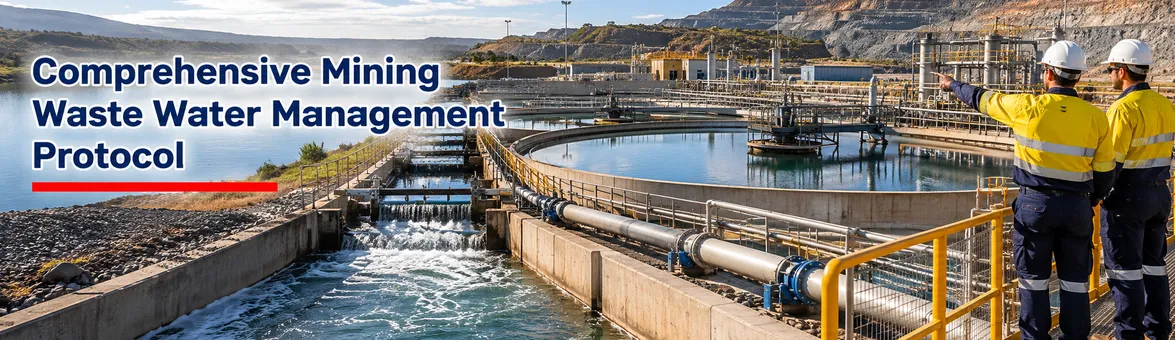
Here it unifies the framework for sanitary sewage treatment with the complex challenges of industrial process water management, providing a holistic overview of water stewardship in mining.
The overall mining wastewater protocol requires two distinct and highly specialized treatment systems to ensure comprehensive environmental protection and operational compliance.
The universal STP framework involves three core stages, adapted for scale and mining-specific operational demands.
The goal is to remove large, coarse solids and protect downstream biological processes.
Screening and Grit Removal: Mechanical screens and grit classifiers remove rags, plastics, and heavy inorganic particles (sand, gravel) that could damage pumps and accumulate in tanks.
Primary Clarification: Large sedimentation tanks allow settleable organic and inorganic solids to gravity-separate as primary sludge, while lighter materials like oils and grease are skimmed from the surface.
This stage uses controlled biological processes to remove dissolved and colloidal organic matter.
Aeration Basin: Wastewater is mixed with a culture of microorganisms (activated sludge) in the presence of oxygen. The microbes consume organic pollutants as food, converting them into new biomass and carbon dioxide.
Secondary Clarification and Sludge Return: The mixture flows into clarifiers where the biological solids settle. A portion of this sludge is returned to the aeration basin to maintain the microbial population, while excess sludge is wasted for further treatment.
Mining often uses compact, high-performance systems where footprint is a premium.
Sequencing Batch Reactors (SBR): A single tank system that operates in batch mode, cycling through treatment phases (fill, react, settle, decant) within the same vessel. SBRs are ideal for fluctuating flows and are highly effective at removing nitrogen and phosphorus.
Membrane Bioreactors (MBR): Combines biological treatment with membrane filtration. The membranes physically separate the treated water from the biomass, producing exceptionally high-quality effluent suitable for direct reuse.
Industrial wastewater is chemically complex, highly variable, and requires specialized, reagent-heavy treatment.
AMD is the most severe long-term issue in mining wastewater, occurring when sulfide-bearing minerals are exposed to air and water.
Chemistry: The process produces sulfuric acid and dissolved heavy metals, which can persist for decades after mine closure, severely contaminating surface and groundwater.
Active Treatment (Neutralization): Involves the addition of alkaline reagents (e.g., hydrated lime) to neutralize the acid and precipitate heavy metals as solid sludge. This requires continuous chemical dosing and generates significant waste.
Process water contains elevated levels of metals and fine particulate matter.
Heavy Metal Treatment: Chemical precipitation is used, where specific reagents (e.g., sulfide precipitation for copper or lead) are added to form insoluble metal compounds that can be settled and filtered.
Suspended Solids (TSS) Treatment: Coagulation and flocculation processes are used to aggregate fine particles, followed by sedimentation or dissolved air flotation (DAF) to remove them.
Mines using cyanide (CN-) for gold extraction must manage its toxicity in process water.
Cyanide Destruction: The SO2/air oxidation process is the industry standard, where sulfur dioxide and air are used to oxidize cyanide to the much less toxic cyanate (CNO-), ensuring safe discharge or reuse.
For FULL DETAILS, regarding the following please send us a request via Email. 1. Detailed Universal Mining Sewage Treatment Framework 2. Advanced STP Technologies and Industrial Mining Wastewater Issues